Agents & decision-making
Mars Water Search
When is sharing information worth the cost?
- Python
- React
- TypeScript
- Gemini
- LangGraph
- smolagents
The experiment
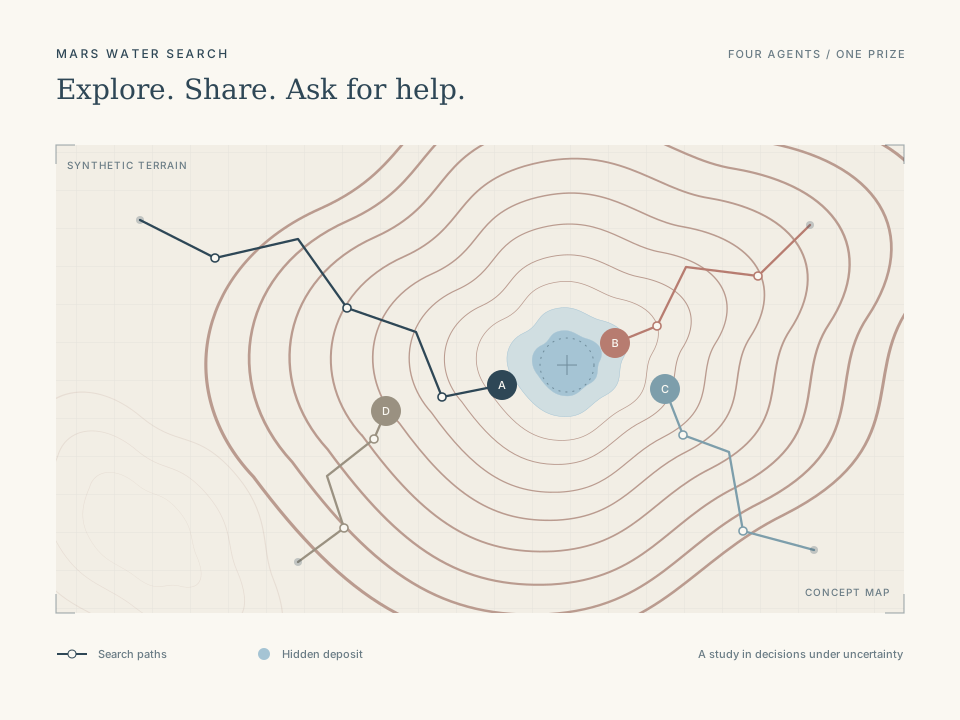
Four AI rovers search a synthetic Martian landscape for a hidden water deposit. Each has a limited budget and a choice: explore independently, join an information pool, or buy private human guidance. Movement, observations, and drilling all cost credits. There is one discovery prize.
Built at Sundai Club’s Wolfram Hack in Boston , the project brings an economic question into an interactive agent environment: how do incentives and uncertainty shape the decision to collaborate?
What I built
A React mission interface makes each rover’s evidence, path, budget, and action reasons visible. Python generates the world, validates actions, and settles rewards. Gemini chooses actions through smolagents tools; LangGraph coordinates simultaneous rounds and resumable interruptions.
The interface supports private and pooled belief maps, human adviser requests, explicit ground-truth revelation, final payouts, and recorded replay. Checkpoints and exported reports make a run inspectable after it ends.
Decisions that matter
- Separate choices from rules. Language models decide what to try; the simulation enforces legal actions, information access, and budget accounting.
- Keep hidden information hidden. Rover inputs, adviser views, and presenter-only ground truth have distinct access boundaries.
- Make interruptions recoverable. Provider pauses and human requests preserve the round state, rather than discarding accepted decisions.
- Show the basis for a decision. Compare evidence, concise action reasons, spending, and outcomes through the interface and replay.
What this demonstrates
An end-to-end agent experiment with an explicit economic environment, durable orchestration, and a human-facing interface.
This is a local research prototype using synthetic terrain and heuristic belief scores. It is not a geological model or a validated benchmark of optimal agent behavior. Repeated, comparable live experiments would be needed to draw conclusions about whether collaboration improves performance.