Machine learning systems
Marketplace ETA Intelligence
What happens after a model makes a prediction?
- Python
- LightGBM
- FastAPI
- PostgreSQL
- Docker
The problem
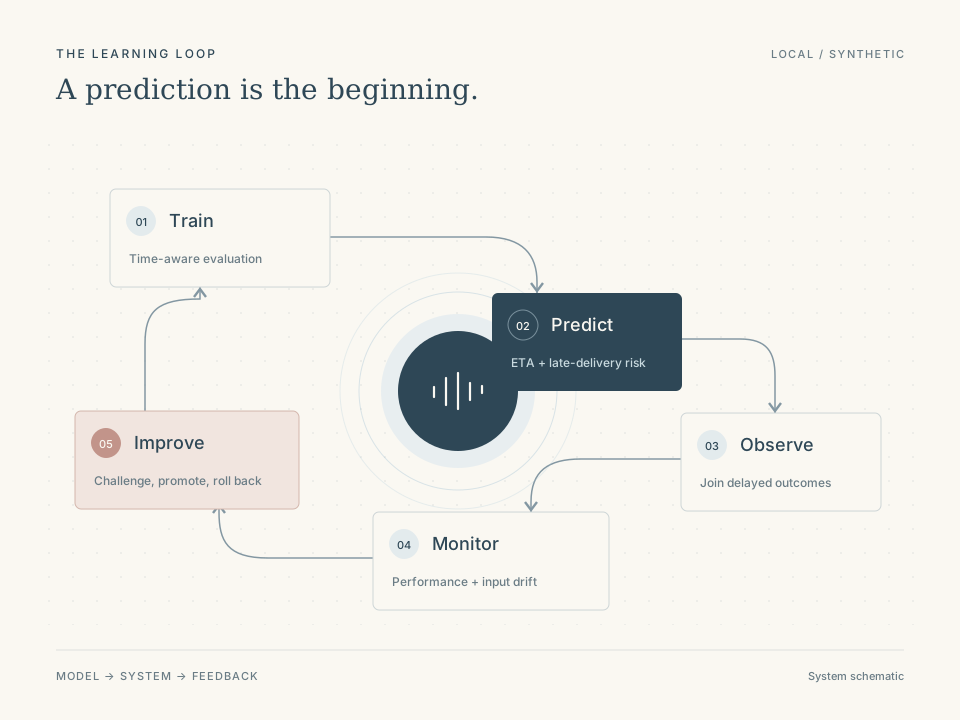
A good model is only one part of a useful ML system. Its inputs need a clear contract, predictions need to meet their eventual outcomes, and a new model needs a defensible reason to replace the old one.
I built a local delivery-time system to work through that entire loop, using an inspectable synthetic market instead of customer data.
What I built
The system predicts delivery duration at order confirmation and separately estimates the risk of missing the promised deadline. LightGBM models sit behind a validated FastAPI service, with Docker packaging and PostgreSQL logging.
A replay harness sends orders through the actual API and joins predictions to outcomes only when those outcomes become available. Monitoring checks performance and input drift. A model registry supports challenger evaluation, promotion, and rollback.
Decisions that matter
- Respect time. Chronological splits and label-availability cutoffs keep future outcomes out of training and evaluation inputs.
- Make the contract explicit. Python, CLI, and HTTP prediction share strict input validation. Invalid requests fail visibly.
- Keep predictions traceable. Saved artifacts carry checksums and metadata; logged predictions retain the model identity that produced them.
- Earn an upgrade. Evaluate challengers on an untouched window, inspect weak segments, and retain a route back to the previous model.
What this demonstrates
The engineering around a model: reproducible training, serving, delayed outcomes, operational checks, and controlled model changes. Everything runs locally within a zero-dollar infrastructure budget.
The data, metrics, and predictions are fully synthetic. This is a production-style learning system; it does not establish real-world delivery accuracy or reliability at scale.