Political economy · Spatial effects
Viral Voting: A study in the information diffusion effects of different social pressure treatments on voter turnout.
Can social pressure spread from one household to the next—and change who turns out to vote?
Abstract
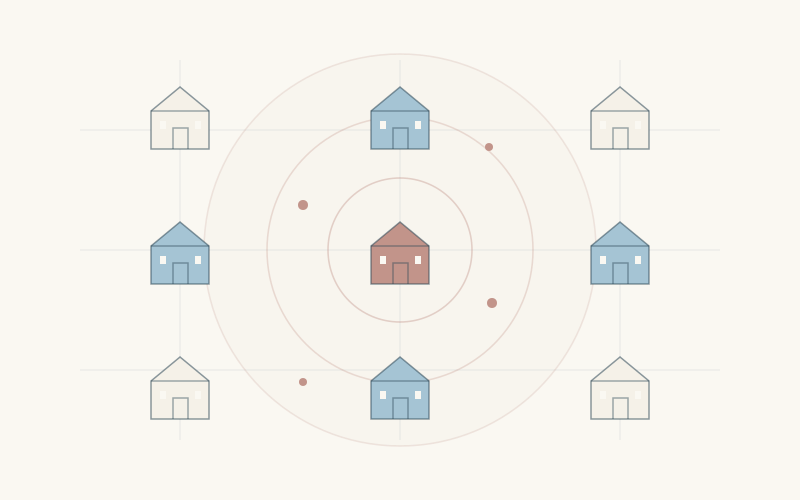
Voter turnout is a cornerstone of democratic stability, yet participation continues to decline across developed nations. This study investigates the mechanisms of information diffusion within geographical neighborhoods, examining how four social pressure treatments: Civic Duty, Hawthorne, Self, and Neighbors—influence both treated and untreated individuals. Using a combination of spatial autoregressive models and causal machine learning, including Double ML and Causal Forests, I re-analyze data from a large-scale field experiment involving 180,002 households. While direct treatment effects remain robust, with the “Neighbors” treatment generating the highest impact (~8%), I find no evidence of simple positive spillovers to untreated neighbors. Crucially, the machine learning models reveal a non-linear, inverted-U relationship between neighborhood treatment intensity and turnout for public pressure treatments. These results suggest that social pressure acts as a contagion only up to a saturation point, beyond which community fatigue or free-riding diminishes the effect. These findings provide a strategic framework for mobilization, suggesting that campaigns should target moderate treatment densities to optimize turnout.